

The purpose of this article is to provide the derivation of the heat transfer matrix of ISO 13786 from the solution of the one-dimensional heat equation (partial differential equation, PDE). The matrix refers to building components as defined in ISO 13786. Inside the same regulation the heat transfer matrix is given without a proof and no derivation is available online.
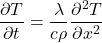
In the one-dimensional heat equation considered in this case, T(x,t) is the temperature which is a function of the x-coordinate and time.
(1) 
This partial differential equation is solved by the so-called method of separation of variables. The solution is supposed to be made of the product of two other functions of one of the variables x and t separately:
(2) 
The constant inside the T(x, t) function is neglected:
(3) 
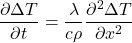
The PDE becomes then:
(4) 
Now, the T(x,t) function is replaced by the two separate functions inside the PDE and the product rule is employed:
(5) 
The above equation is rearranged as follows:
(6) 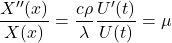
We assume now that μ is a complex number with the real part equal to 0.
(7) 
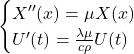
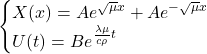
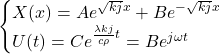
Now the above PDE can be split into two separate ordinary differential equations (ODE) which can be solved separately:
(8) 
(9) 
(10) 
(11) 
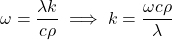
We introduce the new variable ω (angular velocity), which is equal to:
(12) 
The power of the exponentials inside the X(x) function can be rewritten as:
(13) 
(14) 
δ is defined as:
(15) 
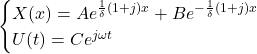
The two differential equations above can be written as:
(16) 
Now, the solution of the one-dimensional heat equation can be written:
(17) 
where
(18) 
The following parameters are introduced:
θ0: maximum temperature at side n of the building component
q0: maximum heat flux density at side n of the building component
θL: maximum temperature at side m of the building component
qL: maximum heat flux density at side m of the building component
The origin of the x-axis is located on side n while the x-value on the opposite side m is equal to L. Therefore, the solution can be written on the two boundaries as:
(19) 
(20) 
(21) ![\begin{equation*} q(0,t) = q_0 e^{j \omega t} = -\lambda \frac{\partial T}{\partial x} \bigg|_{x=0} = -\lambda \left { \left [ A' \frac{1}{\delta} (1+j) e^{\frac{1}{\delta} (1+j) x} - B' \frac{1}{\delta} (1+j) e^{- \frac{1}{\delta} (1+j) x} \right ] e^{j \omega t} \right } \bigg|_{x=0} = \end{equation*}](https://www.fabrizioberloco.com/wp-content/ql-cache/quicklatex.com-156e96c8b86c4e0f1ab11d9ffa2bf4bb_l3.png "Rendered by QuickLaTeX.com")
(22) 
(23) ![\begin{equation*} \Delta T(L,t) = \theta_L e^{j \omega t} = \left [ A' e^{\frac{1}{\delta} (1+j) L} + B' e^{-\frac{1}{\delta} (1+j) L} \right ] e^{j \omega t} \implies \end{equation*}](https://www.fabrizioberloco.com/wp-content/ql-cache/quicklatex.com-377844acba64c9628a5b40a682402a18_l3.png "Rendered by QuickLaTeX.com")
(24) ![\begin{equation*} \implies \theta_L = \left [ A' e^{\frac{1}{\delta} (1+j) L} + B' e^{-\frac{1}{\delta} (1+j) L} \right ] \end{equation*}](https://www.fabrizioberloco.com/wp-content/ql-cache/quicklatex.com-75603930ceb706f7c6d2a5682cb3a3a6_l3.png "Rendered by QuickLaTeX.com")
(25) ![\begin{equation*} q(L,t) = q_{L} e^{j \omega t} = -\lambda \frac{\partial T}{\partial x} \bigg|_{x=L} = -\lambda \left { \left [ A' \frac{1}{\delta} (1+j) e^{\frac{1}{\delta} (1+j) x} - B' \frac{1}{\delta} (1+j) e^{- \frac{1}{\delta} (1+j) x} \right ] e^{j \omega t} \right } \bigg|_{x=L} \end{equation*}](https://www.fabrizioberloco.com/wp-content/ql-cache/quicklatex.com-aed7acfb734c5a9948716a09b9e82be3_l3.png "Rendered by QuickLaTeX.com")
(26) ![\begin{equation*} \implies q_{L} = -\lambda \left [ A' \frac{1}{\delta} (1+j) e^{\frac{1}{\delta} (1+j) L} - B' \frac{1}{\delta} (1+j) e^{- \frac{1}{\delta} (1+j) L} \right ] \end{equation*}](https://www.fabrizioberloco.com/wp-content/ql-cache/quicklatex.com-00ee564b422a255e43ec41ce63cb5cc3_l3.png "Rendered by QuickLaTeX.com")
The four equations obtained are as follows:
(27) ![\begin{equation*} \begin{cases} \theta_0 = (A' + B') \\ q_0 = \frac{\lambda}{\delta} (1+j) (A'-B') \\ \theta_L = \left [ A' e^{\frac{1}{\delta} (1+j) L} + B' e^{-\frac{1}{\delta} (1+j) L} \right ] \\ q_{L} = -\lambda \left [ A' \frac{1}{\delta} (1+j) e^{\frac{1}{\delta} (1+j) L} - B' \frac{1}{\delta} (1+j) e^{- \frac{1}{\delta} (1+j) L} \right ] \end{cases}\end{equation*}](https://www.fabrizioberloco.com/wp-content/ql-cache/quicklatex.com-ffe0175116eb7adb04e77d16624b078a_l3.png "Rendered by QuickLaTeX.com")
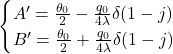
Now we rearrange the first two equations so that parameters A’ and B’ are isolated on left-hand side of each of the two equations:
(28) 
Those two parameters are then replaced in the third and fourth equations:
(29) 
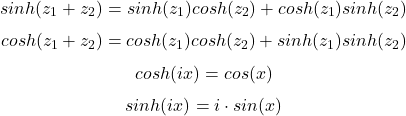
The following properties of hyperbolic functions with complex argument are used in order to obtain the final form of the matrix provided inside regulation ISO 13786:
(30) 
After a few calculations and after relacing parameter ξ, defined as:
(31) 
the final form is obtained:
(32) ![\begin{equation*} \left [ \begin{array}{c} \theta_L \\ q_L \end{array} = \left [ \begin{array}{cc} M_{1,1} & M_{1,2} \\ M_{2,1} & M_{2,2} \end{array} \right ] \cdot \left [ \begin{array}{c} \theta_0 \\ q_0 \end{array} \right ] \end{equation*}](https://www.fabrizioberloco.com/wp-content/ql-cache/quicklatex.com-122c25691db2ff6f4ffd49730461c321_l3.png "Rendered by QuickLaTeX.com")
where:
(33) ![\begin{equation*} M_{1,1} = M_{2,2} = cosh(\xi)cos(\xi) + j sinh(\xi) sin(\xi) \end{equation*} \begin{equation*} M_{1,2} = \frac{\delta}{2\lambda} \left [ sinh(\xi)cos(\xi) + cosh(\xi)sin(\xi) + j \left ( cosh(\xi) sin (\xi) - sinh(\xi) cos(\xi) \right ) \right ] \end{equation*} \begin{equation*} M_{2,1} = - \frac{\lambda}{\delta} \left [ sinh(\xi)cos(\xi) - cosh(\xi)sin(\xi) + j \left ( cosh(\xi) sin (\xi) + sinh(\xi) cos(\xi) \right ) \right ] \end{equation*}](https://www.fabrizioberloco.com/wp-content/ql-cache/quicklatex.com-b3c19f793a45f7be17a6ad7e4bc40748_l3.png "Rendered by QuickLaTeX.com")
Relationship between complex solution and spatial solution
References
Parametri Dinamici UNI EN ISO 13786 – Prof. Marco Manzan
Luca Bonifazi – Comportamento termico dinamico di strutture opache